

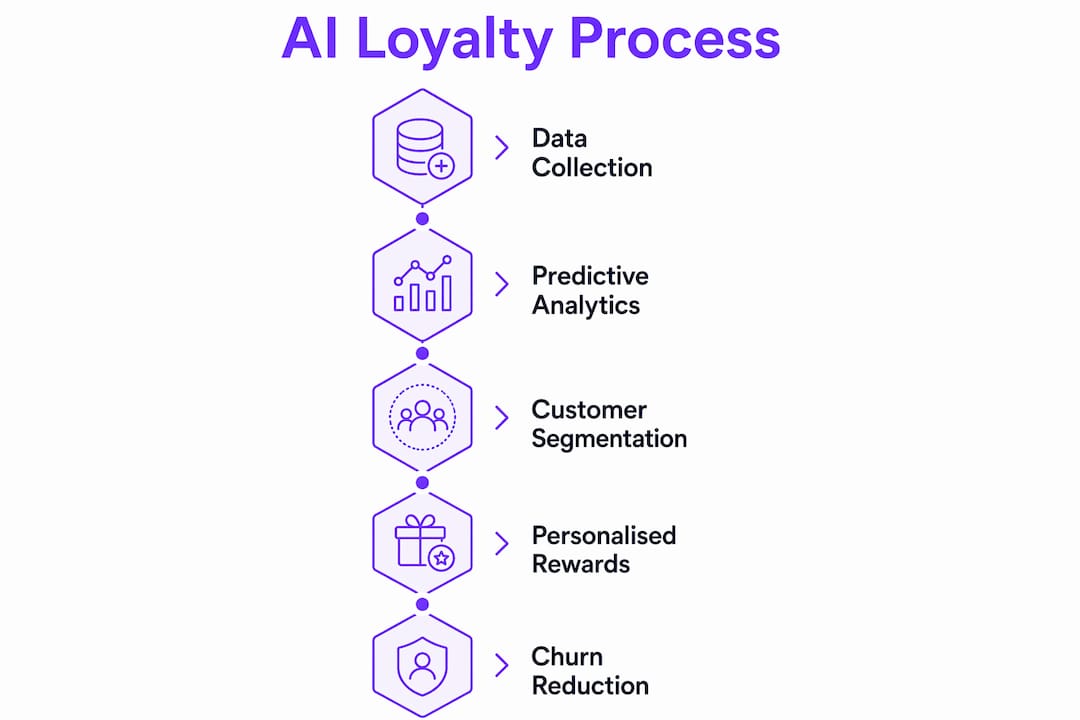
AI loyalty programs are defined as customer retention systems that use machine learning and predictive analytics to personalise rewards, anticipate churn, and automate engagement at scale. Unlike traditional points-based schemes, these programmes analyse individual behaviour in real time and adapt their offers accordingly. The result is a fundamentally different relationship between brand and customer, one built on relevance rather than repetition. For businesses and marketers, understanding how to implement AI loyalty correctly, and where it can go wrong, is now a core commercial skill.
How do AI loyalty programs personalise customer engagement?
Personalisation is the primary advantage AI brings to loyalty management. Traditional programmes segment customers by broad demographics: age, location, spend tier. AI goes further by analysing behavioural patterns, including purchase frequency, browsing sequences, support interactions, and time-of-day activity, to build granular individual profiles.
Personalised engagement and AI automation improve loyalty programme effectiveness by reducing generic communications and increasing relevance. That matters because generic outreach is the single fastest way to train customers to ignore your messages.

Dynamic segmentation is the technique that makes this possible. Rather than assigning a customer to a fixed tier, AI models continuously re-score each individual based on recent behaviour. A customer who has not purchased in 30 days but has visited the site three times this week sits in a very different risk and opportunity category than one who is simply quiet.
Practical personalisation through AI typically delivers:
- Offers timed to individual purchase cycles rather than calendar promotions
- Reward categories matched to demonstrated product preferences
- Communication channels selected based on past response rates
- Escalating incentives triggered by declining engagement signals
Pro Tip: Run an A/B test comparing AI-personalised reward emails against your current batch-and-blast approach for 30 days. The open rate gap alone usually justifies the investment.
How does AI predict and reduce customer churn?
Churn prediction is where artificial intelligence customer loyalty programmes deliver their clearest measurable return. AI models detect early warning signals weeks or months before a customer cancels. AI predicts churn risk from signals like login frequency, support tickets, and usage patterns, giving retention teams time to intervene before the decision is made.
The intervention itself matters as much as the prediction. AI-driven "smart" cancellation flows match the specific reason for churn to a personalised counter-offer. A customer leaving because of price receives a discount. One leaving because of a missing feature receives a roadmap update or a workaround. Smart cancellation flows matching churn reasons to personalised offers reduce churn by 39–54% at the cancellation moment compared to passive methods. That is not a marginal improvement. It is the difference between retaining roughly half your at-risk customers and losing them entirely.
The data feeding these models does not need to be exotic. Structured exit surveys are one of the most underused tools available. Integrating structured exit surveys in cancellation flows yields data that directly feeds AI-driven retention and win-back campaigns. Most businesses collect this data poorly or not at all.
| Churn signal | AI detection method | Retention action |
|---|---|---|
| Declining login frequency | Usage trend modelling | Re-engagement email with personalised offer |
| Rising support ticket volume | Sentiment and volume analysis | Proactive outreach from customer success |
| Abandoned cart patterns | Behavioural sequence tracking | Targeted discount or free shipping trigger |
| Reduced reward redemption | Loyalty activity scoring | Bonus points or exclusive reward unlock |
Pro Tip: Connect your support ticketing system to your AI retention model. A spike in complaints from a customer segment is a churn signal, not just a service problem.
What are the trust and privacy challenges of AI loyalty?
Consumer trust in AI is not stable. Consumer trust in AI dropped from 72% to 58% in a single year, even as over 50% of consumers say they are comfortable filtering brand communications entirely through AI. That gap reveals a real tension: customers want relevant, personalised experiences but are increasingly wary of how brands achieve them.
AI intensifies loyalty management tensions such as predictive analytics versus opacity, personalisation versus privacy, and automation versus human relationship erosion. These are not abstract concerns. A customer who receives an offer that feels uncannily well-timed may feel served. One who receives an offer that feels intrusive may feel survived. The line between the two is thinner than most marketers assume.
Addressing these tensions requires concrete practices, not vague commitments to "responsible AI":
- Publish a plain-language explanation of how your loyalty programme uses customer data
- Give customers genuine control over what data feeds their personalisation
- Avoid using sensitive inferred data (health signals, financial stress indicators) in reward targeting
- Audit AI outputs regularly for discriminatory patterns in offer distribution
Transparency is not just an ethical obligation. It is a commercial one. Customers who understand and trust how a programme works engage with it more deeply and for longer.
Pro Tip: Align your AI tools with your human customer experience teams from the start. AI should surface the insight; a human should make the final call on sensitive interventions.
How to implement AI loyalty: infrastructure and organisational readiness
Technology is the easier half of AI loyalty implementation. The harder half is organisational. Successful AI loyalty programmes require organisational adaptation to mitigate socio-technical mismatches, balancing technology with culture and processes. A business that deploys an AI rewards system without retraining its customer service team, updating its data governance policies, or aligning its marketing workflows will underperform regardless of the quality of the technology.
The technical integration priorities are clear. AI loyalty systems need clean, structured data from CRM platforms, e-commerce systems, support tools, and payment processors. Without unified data, the models produce unreliable outputs. AI-generated personalised emails and automated workflows enable scalable retention communication, but only when the underlying customer data is accurate and consistently structured.
Organisational readiness means answering three questions before deployment:
- Who owns the AI loyalty programme internally, and do they have authority to act on its outputs?
- How will the programme's performance be measured, and over what time horizon?
- What happens when the AI recommendation conflicts with a human judgement call?
Iterative testing is the most reliable path forward. Start with one use case, such as churn prediction for your highest-value customer segment, measure it rigorously, and expand from there. Businesses that attempt to deploy every AI loyalty feature simultaneously typically produce a confusing customer experience and unreliable performance data.
The feature categories worth evaluating in any AI loyalty platform include: behavioural data ingestion and real-time scoring, predictive churn modelling, personalised offer generation, automated communication workflows, and on-chain or auditable reward validation. The last point matters particularly for programmes that include token-based or digital asset rewards, where tamper-proof settlement is a trust requirement, not a nice-to-have.
Key takeaways
AI loyalty programmes outperform traditional schemes because they act on individual behaviour in real time, not on demographic assumptions made months ago.
| Point | Details |
|---|---|
| Personalisation drives engagement | AI analyses behavioural signals to deliver relevant offers, reducing the generic communications that erode loyalty. |
| Churn prediction requires early signals | Login frequency, support tickets, and usage patterns give AI models weeks of warning before a customer cancels. |
| Smart cancellation flows work | Matching counter-offers to specific churn reasons reduces cancellation rates by 39–54% compared to passive methods. |
| Trust requires transparency | Consumer trust in AI fell from 72% to 58% in one year; clear data practices are now a commercial necessity. |
| Organisational alignment is non-negotiable | Technology without process and cultural change produces socio-technical mismatches that undermine programme performance. |
Why most AI loyalty programmes fail before they start
The uncomfortable truth I have observed across a decade of watching brands adopt new engagement technology is this: the technology is rarely the problem. Businesses invest in AI rewards systems, integrate the data feeds, and then wonder why results are flat. The answer is almost always the same. Marketers underperform by focusing on AI technology without simultaneously evolving the organisational human processes that support new loyalty dynamics.
AI is not a loyalty strategy. It is a capability that amplifies whatever strategy you already have. If your underlying value proposition is weak, AI will personalise a weak offer at scale. If your customer service team is not aligned with your retention model, the AI will flag a churn risk that nobody acts on. I have seen this pattern repeat itself across retail, subscription services, and digital platforms alike.
The brands that get this right share one characteristic: they treat AI loyalty implementation as an organisational change programme, not a technology project. They retrain teams, update incentive structures, and build feedback loops between AI outputs and human decisions. They also accept that balancing AI automation with authentic human-to-brand relationships is an ongoing discipline, not a problem you solve once at deployment.
My honest recommendation: before you evaluate any AI loyalty platform, map your current retention process on paper. Identify where decisions are made, who makes them, and what data they currently use. That map will tell you more about your readiness than any vendor demo.
— Marcus
Gamiprotocol: gamified loyalty infrastructure for the AI era
Businesses that want to move beyond points-and-tiers loyalty without rebuilding their entire technology stack have a practical option in Gamiprotocol. The platform provides a universal gamification layer that lets customers earn XP, rewards, and tokens across multiple platforms without requiring partners to overhaul their existing systems.
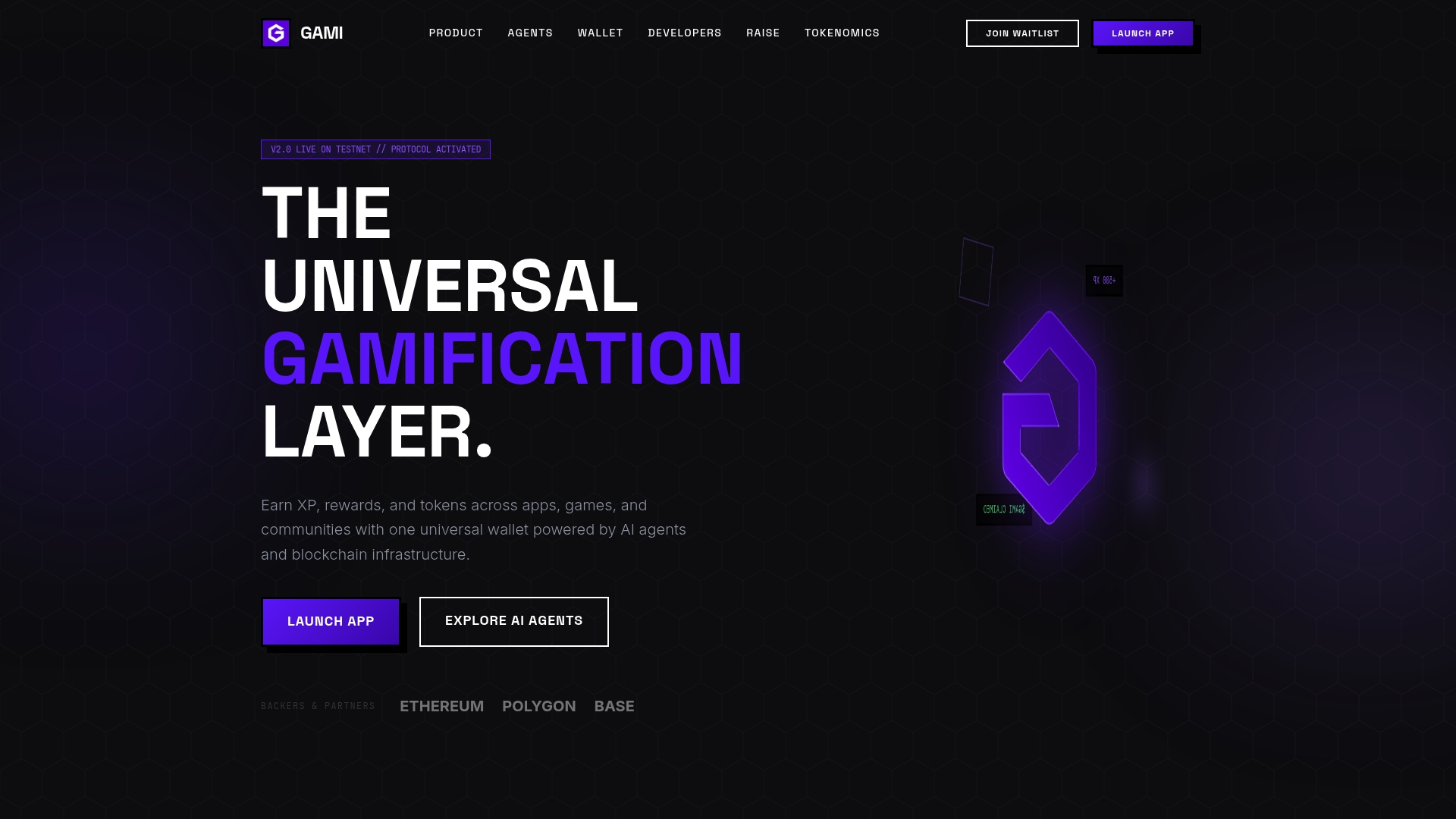
Gamiprotocol's proprietary AI agents handle automated quest logic and reward distribution, while on-chain settlements provide tamper-proof validation of every reward transaction. The Gami Wallet gives customers a single dashboard to track achievements and benefits across all partner platforms. For marketers building an AI-driven customer engagement strategy, that kind of unified infrastructure removes the integration complexity that typically slows deployment. Gamiprotocol is worth evaluating as a foundation layer for any business serious about personalised loyalty at scale.
FAQ
What are AI loyalty programs?
AI loyalty programmes are customer retention systems that use machine learning to personalise rewards, predict churn, and automate engagement based on individual behaviour rather than fixed rules.
How does AI reduce customer churn in loyalty programmes?
AI detects early churn signals such as declining login frequency and rising support tickets, then triggers personalised counter-offers. Smart cancellation flows using this method reduce churn by 39–54% compared to passive approaches.
What data does an AI loyalty system need to function?
AI loyalty systems require structured data from CRM platforms, e-commerce systems, support tools, and payment processors. Inconsistent or siloed data produces unreliable model outputs.
How do you address privacy concerns in AI loyalty programmes?
Publish a plain-language explanation of how customer data is used, give customers control over their personalisation settings, and audit AI outputs regularly for discriminatory patterns in offer distribution.
How long does it take to implement an AI loyalty programme?
Implementation timelines vary by organisational complexity and data readiness. Starting with a single use case, such as churn prediction for high-value customers, and expanding iteratively is the most reliable approach.