

Employee engagement gamification applies game design principles to work activities to trigger intrinsic motivation, not just hand out prizes. At its core, it uses feedback loops, progress tracking, recognition, and meaningful challenges to satisfy three psychological needs identified by self-determination theory: autonomy, competence, and relatedness. When those needs are met, employees become more productive, show lower absenteeism, and report higher job satisfaction. The critical distinction is between gamification that genuinely fulfils these needs and superficial tactics that inject short-term excitement through points or badges alone. Research grounded in self-determination theory confirms that simplistic mechanics fail to sustain engagement; the design must go deeper.
Key game elements that drive real engagement:
- Feedback loops: real-time signals that tell employees how they are progressing
- Progress tracking: visible milestones that build a sense of competence over time
- Recognition systems: badges, peer visibility, and public acknowledgement that satisfy relatedness
- Meaningful challenges: goal-setting and task difficulty calibrated to stretch without overwhelming
- Social mechanics: team competitions and collaborative quests that create belonging
Proven strategies to boost employee engagement through gamification
1. Build feedback into daily workflows
Immediate, specific feedback is the single most reliable gamification mechanic. Employees who receive real-time signals about task quality adjust behaviour faster and feel a stronger sense of competence. The feedback does not need to be elaborate; a progress bar on a training module or a completion notification after a customer call both qualify.
2. Use goal-setting and personal challenge systems
Goal-setting mechanics work because they satisfy autonomy. Letting employees choose their own challenge level, or set personal targets within a broader team objective, produces stronger commitment than top-down assignments. Gamified HRM research using structural equation modelling across 418 respondents found that goal-setting and task challenges directly strengthen employees' sense of mastery and autonomy.

3. Deploy recognition systems with peer visibility
Badges and leaderboards work best when they create social visibility rather than pure competition. A leaderboard that shows everyone's progress, not just the top three, reduces the winner-takes-all dynamic that alienates lower performers. Peer-nominated badges add a relatedness dimension that top-down awards cannot replicate.
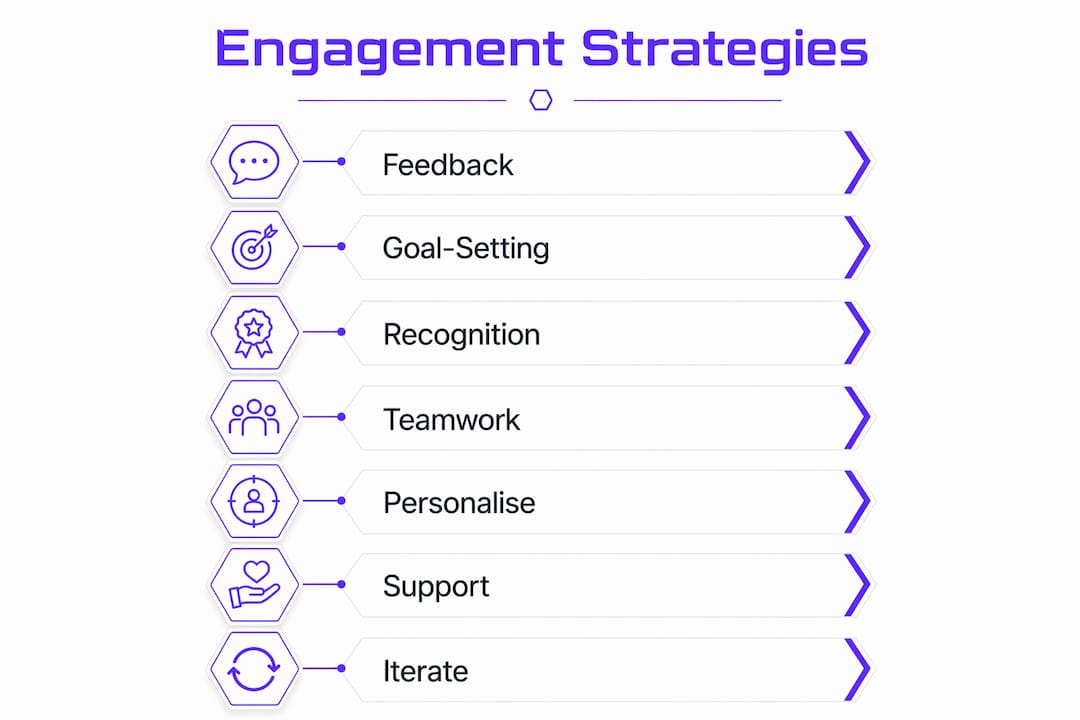
4. Introduce team competition and collaborative quests
Social mechanics satisfy the need for relatedness more directly than any individual reward. Team-based challenges, cooperative missions, and shared progress boards encourage knowledge-sharing and reduce the isolation that remote and hybrid workers often report. Systematic reviews of 49 empirical studies confirm that contextual fit, including social design, is a key moderator of gamification success.

5. Personalise for diverse employee needs
A single gamification scheme rarely fits an entire workforce. Employees with low gaming preference respond less strongly to competitive mechanics, while those with high gaming preference thrive on them. Segmenting your workforce and offering opt-in challenge tracks, or adjusting difficulty by role, produces better outcomes than a uniform rollout.
Pro Tip: Run a brief preference survey before launch. Ask employees whether they prefer solo challenges, team competition, or creative quests. Use the results to configure at least two parallel tracks rather than one default experience.
6. Combine progression, social visibility, and support
Organisations that focus only on winners see sharp post-launch drop-off. Sustaining engagement requires combining a clear progression system, social visibility for all participants, and access to support resources. A UK retailer's gamified learning programme using badges, XP, and leaderboards achieved average logins of over 11 times per employee within months, precisely because all three elements worked together.
7. Iterate based on data, not assumptions
Pilot testing before a full rollout is not optional. Design quality and organisational fit are the two strongest moderators of whether gamification succeeds or fails. Run a controlled pilot with one team or department, measure intrinsic motivation and participation rates, then adjust mechanics before scaling.
How gamification drives employee motivation: the evidence
Intrinsic motivation is the mechanism that connects gamification to sustained engagement. When game mechanics satisfy autonomy, competence, and relatedness, employees internalise their motivation rather than relying on external rewards. A study of 418 respondents using structural equation modelling found that intrinsic motivation partially mediates the relationship between gamified HRM and work engagement, with a significant indirect effect (β = 0.18).
Gamification also triggers self-leadership processes. According to a conceptual model published in Administrative Sciences, game elements activate self-management and natural reward processes simultaneously, producing a state of self-concordance where employees perceive close alignment between their work tasks and personal values. That alignment drives motivation far beyond what a bonus or prize can achieve.
| Mechanism | Effect on engagement | Key condition |
|---|---|---|
| Intrinsic motivation (mediator) | Partial mediation confirmed (β = 0.18) | Psychological need satisfaction required |
| Gaming preference (moderator) | Stronger effect for high-preference employees | Personalisation needed |
| Organisational support (moderator) | Amplifies gamification impact | Leadership buy-in essential |
| Self-concordance | Aligns tasks with personal values | Requires meaningful challenge design |
Key finding: Gamified HRM exerted a significant positive effect on employee work engagement (β = 0.31, p < 0.001) across 418 respondents, with intrinsic motivation serving as a partial mediator.
Effectiveness is not uniform. Employees with low gaming preference or working in organisations with weak support structures show considerably weaker responses to the same mechanics. Measuring psychological need satisfaction, not just login counts or points accrued, gives a far more accurate picture of whether your programme is working.
Future trends shaping workplace gamification
The next generation of workplace gamification is moving well beyond points and badges. Several shifts are already visible in 2026:
- AI-driven personalisation: adaptive quest systems that adjust difficulty and reward type based on individual behaviour patterns, removing the need for manual segmentation
- Blockchain-verified rewards: on-chain settlement of achievements and tokens creates tamper-proof records, building employee trust in the fairness of reward distribution
- Value-aligned design: growing emphasis on self-concordance means programmes are being designed to connect tasks with employees' personal goals and career aspirations, not just team KPIs
- Cross-platform reward portability: employees increasingly expect XP and rewards earned in one context (training, performance, wellbeing) to carry across platforms
- Data-driven iteration: real-time analytics dashboards allow HR teams to spot drop-off points and adjust mechanics within days rather than waiting for quarterly reviews
- Legal and ethical scrutiny: UK employers must consider GDPR compliance when collecting behavioural data through gamification platforms, and should audit for fairness to avoid inadvertently disadvantaging protected groups under the Equality Act 2010
How Gamiprotocol enhances employee engagement through technology
Gamiprotocol provides a universal gamification infrastructure that addresses the core technical barriers organisations face when scaling engagement programmes. Rather than requiring partners to rebuild existing systems, it sits as a layer across platforms, distributing XP, rewards, and tokens wherever employees work.
Key capabilities relevant to HR programmes:
- Cross-platform XP and rewards: employees accumulate experience points across training platforms, performance tools, and wellbeing apps in a single wallet
- AI-powered quest automation: proprietary AI agents handle quest logic and reward distribution automatically, reducing administrative overhead for HR teams
- On-chain settlement: tamper-proof validation of achievements builds the trust that sustains long-term participation
- Non-transferable XP: prevents gaming the system while preserving the motivational value of earned status
Pro Tip: When integrating a gamification infrastructure like Gamiprotocol into existing HR programmes, map your current employee touchpoints first. Identify the three or four moments where motivation typically drops, then design quests specifically around those friction points rather than gamifying everything at once.
How gamification drives employee engagement
Gamification drives engagement by making the invisible visible. Employees who cannot see their progress, compare their standing, or receive acknowledgement for effort tend to disengage from repetitive tasks. Game mechanics solve this by creating a continuous feedback loop: action, signal, reward, next action. The brain's dopamine system responds to this loop, reinforcing the behaviour and building habitual engagement. Research from the Wharton Neuroscience Initiative notes that gamification activates the brain's reward system, with productivity improvements linked to motivational mechanics rather than superficial excitement.
The effect is strongest when mechanics are tied to meaningful work rather than arbitrary tasks. Employees who earn recognition for genuinely difficult achievements report higher satisfaction than those who collect badges for routine compliance.
Practical implementation challenges and how to address them
The most common failure mode is launching too broadly, too fast. Organisations that roll out gamification across the entire workforce simultaneously rarely have the data to know what is working. A phased approach, starting with one department and measuring intrinsic motivation alongside participation, produces far better outcomes.
Resistance from employees who do not identify as "gamers" is real and predictable. Framing mechanics around professional development and recognition rather than competition reduces this friction considerably. Offering opt-out options for competitive elements while keeping progress tracking available to everyone tends to improve overall adoption.
Technical integration is a genuine barrier for organisations with legacy HR systems. Platforms that operate as an overlay layer, rather than requiring a full system rebuild, reduce both cost and implementation time.
Measuring whether your gamification programme is working
Points and logins are the wrong primary metrics. Research measuring intrinsic motivation as the mediating variable between gamified HRM and engagement shows that psychological need satisfaction predicts sustained engagement far better than surface participation data.
Practical metrics to track alongside participation rates:
- Autonomy satisfaction: do employees feel they have meaningful choice within the programme?
- Competence satisfaction: are employees progressing and feeling capable?
- Relatedness satisfaction: are social mechanics creating genuine connection?
- Perceived organisational support: do employees believe the organisation is invested in their development?
Pulse surveys using validated scales (such as the Basic Psychological Needs Satisfaction scale) give HR teams a reliable signal within weeks of launch.
Legal and ethical considerations for UK employers
UK employers operating gamification programmes must comply with the UK GDPR when collecting and processing behavioural data generated by game mechanics. Employees should be informed clearly about what data is collected, how it is used, and how long it is retained. Consent or legitimate interest must be documented.
Fairness is a separate concern. Leaderboards and competitive mechanics can inadvertently disadvantage employees with disabilities, caring responsibilities, or part-time contracts, potentially creating exposure under the Equality Act 2010. Designing mechanics that reward effort and improvement rather than raw output reduces this risk. HR teams should conduct an equality impact assessment before any large-scale gamification rollout.
Case studies from UK organisations
A UK retailer's gamified learning programme, built around badges, XP, and leaderboards, achieved average logins exceeding 11 times per employee within months of launch. The programme combined all three core elements: a clear progression system, social visibility through leaderboards, and peer recognition through badges. The retailer did not rely on a single mechanic; the combination was the point.
UK organisations in financial services and professional services have adopted gamified compliance training to address the persistent problem of low completion rates. By replacing mandatory e-learning modules with quest-based formats that award XP for completion and accuracy, several firms have reported measurable improvements in both completion rates and knowledge retention, consistent with the findings from systematic reviews of gamification in training.
Key takeaways
Effective employee engagement gamification works through intrinsic motivation, not excitement alone. Programmes that satisfy autonomy, competence, and relatedness consistently outperform those built on points and prizes.
| Point | Details |
|---|---|
| Intrinsic motivation is the mechanism | Gamified HRM enhances engagement with intrinsic motivation as a partial mediator (β = 0.18). |
| Personalisation determines effectiveness | Gaming preference and organisational support both moderate how strongly gamification drives engagement. |
| Measure psychological needs, not just logins | Autonomy, competence, and relatedness satisfaction predict sustained engagement better than participation counts. |
| Combine progression, visibility, and support | Programmes using all three elements together sustain engagement far longer than single-mechanic approaches. |
| UK legal compliance is non-negotiable | UK GDPR and the Equality Act 2010 both apply to gamification data collection and competitive mechanics. |